

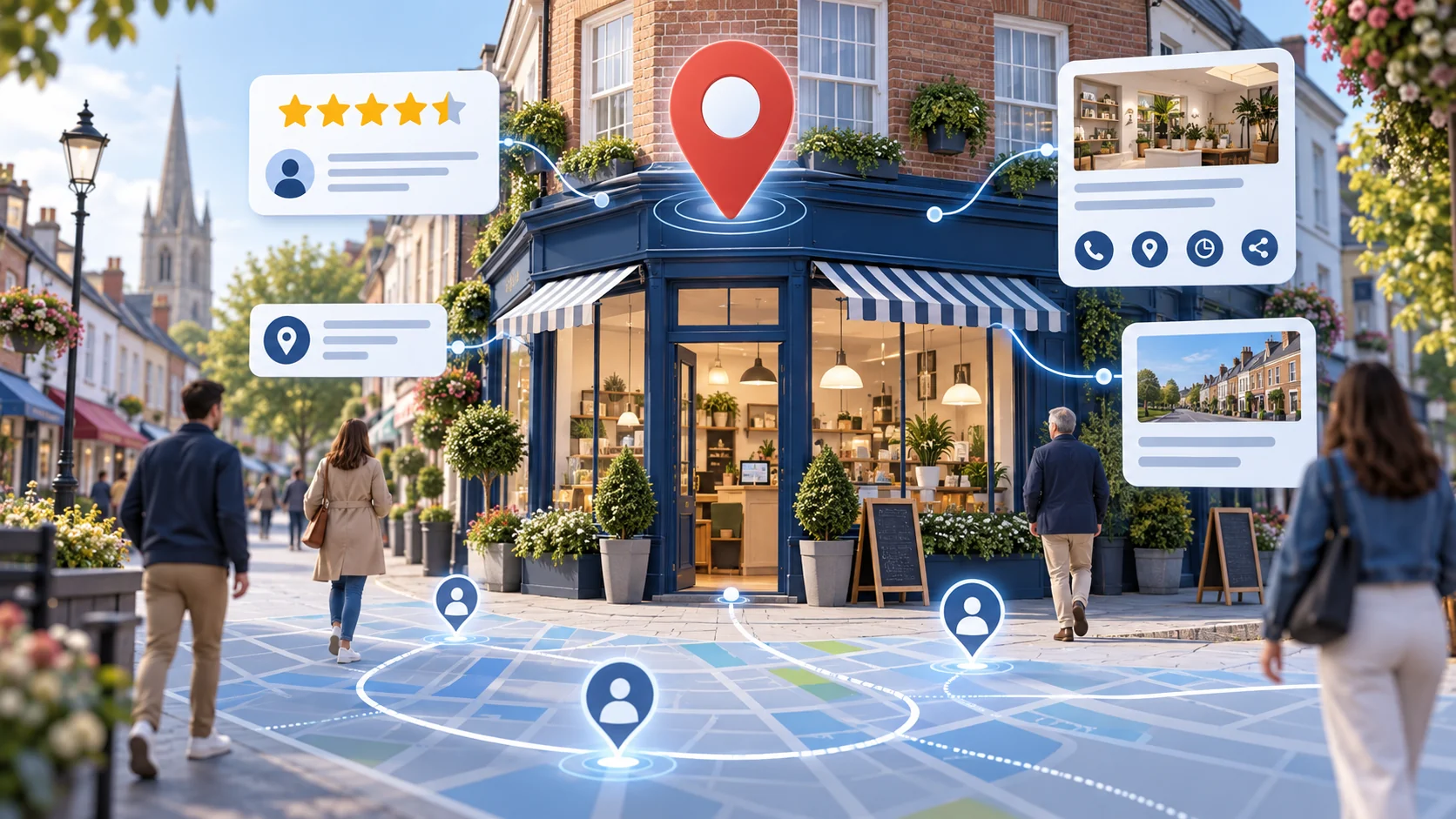
Local SEO helps nearby customers understand that your business is relevant, credible and able to serve them. For a UK small business, that means connecting an accurate Google Business Profile with useful website pages, genuine reviews and meaningful measurement.
This practical guide focuses on the whole local-search system. If you only need help with the listing itself, use our separate Google Business Profile checklist for the detailed field-by-field checks.
Make its business details accurate, choose the services and locations it can genuinely serve, create useful website destinations, collect honest feedback and track which local enquiries become qualified opportunities. Do the fundamentals before creating dozens of pages.
Make services, locations and customer needs clear on the profile and website.
Support claims with reviews, real project evidence and trustworthy local references.
Connect calls and forms to lead quality, opportunities and customers.
What is local SEO for a small business?
Local SEO helps a business appear for searches with local intent: a named town or postcode, “near me”, or a service Google interprets as location-dependent. Results can include website listings, a map and Business Profiles.
Google says local results are mainly based on relevance, distance and prominence: how well the business matches the search, how far it is from the location used, and how well known it is. Google also says businesses cannot request or pay for a better local ranking. A sound strategy therefore removes uncertainty throughout the customer journey rather than relying on a trick. See Google’s local ranking guidance.
“More local traffic” is too broad. Define the profitable services, the places you can reliably serve and what a qualified enquiry looks like. A smaller number of appropriate enquiries can be more valuable than a larger number from outside your service area.
Build the local foundations first
Begin with facts customers can verify: the approved trading name, phone number, website, hours, location or service area, services and conversion routes. Give one person ownership of updates so business changes do not create conflicting information.
| Foundation | What good looks like | First check |
|---|---|---|
| Business identity | The same real-world name is used across the website, profile and important listings. | Search the brand and old names; document anything that needs correcting. |
| Location model | A genuine storefront, service-area or hybrid setup that reflects how customers are served. | Confirm whether customers are actually received at the displayed address. |
| Services and areas | A focused list based on delivery capacity and commercial value. | Ask which services and postcodes produce suitable customers, not merely enquiries. |
| Conversion path | Calls, forms and bookings work well on mobile and reach the right person. | Complete each journey as a customer and check the follow-up. |
Keep Google Business Profile accurate
Claim and verify the correct profile, use the real business name, select a precise genuine primary category and keep contact information and hours current. Add relevant services, attributes and authentic photos. Google’s representation guidelines require a real-world identity and precise address or service area.
Do not add keywords to the name or create profiles without a genuine operating presence. Service-area businesses should use one profile for the area served and hide an address where customers are not received. Google permits up to 20 named service areas and advises that the overall boundary should not normally exceed about two hours’ driving time; check its service-area guidance.
The Business Profile can introduce the business, but the website has to explain the offer, answer risk-sensitive questions and convert interest. Complete the profile with our step-by-step GBP checklist, then return to the website work below.
Create website pages that earn their place
Give every core service a clear page explaining what is offered, who it suits, how delivery works and what happens next. Use natural titles and headings, descriptive URLs and internal links from service hubs and relevant articles. Google’s SEO Starter Guide recommends logical organisation, descriptive URLs and useful links.
When does a location page deserve to exist?
A staffed branch normally merits its own page with the correct contact details, directions, services, team and local proof. A service-area page can be useful when the business has meaningful experience and a distinct proposition there. Build it around relevant projects, genuine testimonials, coverage information and a clear enquiry route—not a template in which only the town changes. Otherwise, consolidate the content into a strong regional page.
Ask whether the page would still help a prospective customer if search engines did not exist. If it answers local availability, expertise, proof, logistics and next steps, it probably has a purpose. If it simply repeats a generic service page, improve or remove it.
Support clarity with structured data
Appropriate LocalBusiness or Organization structured data can help Google understand business details; it does not guarantee a special search appearance. Use the most specific applicable type, keep marked-up details consistent with visible content, validate the result and maintain it after changes. Google’s LocalBusiness documentation explains the eligible properties and testing process.
Use reviews, citations and local links as evidence
Build an honest review routine
Ask genuine customers for feedback after a successful visit, delivery, milestone or resolved case. Invite an honest review and respond professionally. Never offer incentives, filter invitations to happy customers or prescribe keywords. Google prohibits incentivised reviews and recommends valuing balanced feedback in its review guidance.
Reviews are also business intelligence. Tag recurring comments about speed, communication, outcomes or confusion. Feed them into service pages, processes and FAQs rather than treating review count as an isolated score.
Correct important citations before creating more
A citation is a reference to the business on another website, often with its name, address and phone number. Prioritise sources customers may consult: trade bodies, professional memberships, local chambers, credible sector directories, partners and established map platforms. Correct obsolete details and true duplicates where possible.
Do not purchase hundreds of low-quality listings merely to increase a count. A smaller, maintained set helps customers reach the right business and avoids leaving obsolete details scattered across the web.
Earn links through local participation
Useful local links often follow real relationships: membership, sponsorship, events, supplier stories, expert contributions or approved case studies. Seek legitimate references that send relevant people and support the business’s activity. Google notes that links help users and search engines discover pages and recommends descriptive anchor text in its link guidance.
Measure visibility, enquiries and commercial value
Local SEO is not complete when a ranking report turns green. Use Google Business Profile performance for profile interactions and Search Console for website visibility, then connect both to analytics and the CRM.
Futuro Digital Consultancy connects Google Business Profile, local listings and service or location content with the website conversion path and CRM source data. We assess calls and enquiries alongside lead quality, rather than treating rankings as the final result.
| Layer | Useful measures | Question to answer |
|---|---|---|
| Visibility | Relevant non-brand queries, impressions, pages and UK search trends. | Are the right services and locations becoming discoverable? |
| Interaction | Website clicks, calls, direction requests, bookings and form starts. | Does visibility produce meaningful action? |
| Lead quality | Service required, location, fit, source and qualification outcome. | Are enquiries suitable and serviceable? |
| Commercial outcome | Opportunities, won business, revenue and time to conversion. | Which local activity contributes to customers? |
Business Profile reports can include views, calls, directions and website clicks for verified profiles. Search Console reports clicks, impressions, click-through rate and average position by dimensions including query, page, country and device. Check Google’s Business Profile performance guidance and Search Console documentation before comparing periods.
Add documented UTM parameters to profile links and test form and telephone tracking. Compare like-for-like periods where seasonality matters. Treat rank grids as diagnostic context because results can vary by location, device and search context.
Multi-location and service-area pitfalls
- One national contact page for several branches: create clear, maintained branch destinations so customers can find the right details and services.
- Duplicate town pages: replace mass-produced variants with fewer pages containing genuine local evidence and a reason to exist.
- Profiles for virtual locations: only create profiles that satisfy Google’s eligibility and staffing requirements.
- Overstated service areas: describe where the team can deliver reliably rather than every location it hopes to rank for.
- Unmanaged ownership: keep business-controlled access and assign individual manager permissions; do not leave the only login with an agency or former employee.
- Aggregated reporting only: compare locations, services and lead quality so a strong branch does not conceal another branch’s problems.
A prioritised 30/60/90-day local SEO plan
The sequence below is designed for a small team. Fix accuracy and conversion first, improve the pages that already matter next, then build proof and a repeatable operating rhythm.
- Define priority services, areas and qualified leads.
- Audit profile eligibility, ownership and details.
- Correct website contact information and broken journeys.
- Set up Search Console, analytics, UTMs and CRM source capture.
- Benchmark enquiries and commercial outcomes.
- Strengthen core service pages around customer decisions.
- Create or improve justified branch and service-area pages.
- Add descriptive internal links from relevant pages.
- Implement and validate suitable structured data.
- Correct the most visible inaccurate citations.
- Launch a policy-compliant review routine.
- Add real photos, examples and testimonials with permission.
- Pursue useful local relationships and references.
- Review queries, actions, qualified leads and wins.
- Schedule monthly maintenance and quarterly planning.
Repeat what produces qualified demand. Expand only where the business has capacity, evidence and a useful page to publish. Futuro Digital Consultancy’s wider SEO optimisation services can connect local work with technical SEO, content and conversion tracking.
The small-business local SEO checklist
- Define the services, locations and customer types that have commercial priority.
- Confirm whether the business is a storefront, service-area or hybrid operation.
- Verify the Business Profile and keep access in a business-controlled account.
- Use the genuine business name, address or service area, phone number and hours.
- Give each core service a useful, indexable website destination.
- Create location pages only when they offer distinct and accurate local value.
- Make important pages easy to reach through descriptive internal links.
- Request honest reviews consistently and respond without revealing private details.
- Correct priority listings and remove obsolete business details where possible.
- Build local references through genuine partnerships, expertise and participation.
- Track profile actions and organic visits through to qualified leads and customers.
- Review accuracy monthly and strategy quarterly, as well as after every business change.
Local SEO for small business FAQs
How long does local SEO take?
There is no universal timetable. Eligibility, competition, distance and the current website all differ. Establish a baseline, complete the 90-day plan and judge progress through relevant visibility, qualified enquiries and commercial outcomes.
Do I need a Google Business Profile for local SEO?
An eligible local business should normally maintain an accurate profile because it can appear on Search and Maps. The profile is not the whole strategy: website pages, customer proof, third-party references and measurement still matter.
Can a service-area business rank in towns without an office?
It can describe the places it genuinely serves without displaying an address. Virtual offices or duplicate profiles can breach Google’s rules. Area pages should be useful and must not imply a staffed branch that does not exist.
Should every town have its own page?
No. Publish a town page when there is distinct demand, delivery capability and enough accurate local information to help a customer. Otherwise, a stronger regional page is often clearer than a collection of near-duplicates.
Are directory citations still worth doing?
Maintain the directories, memberships and platforms that customers genuinely use or trust. Correct business details matter; indiscriminate bulk submissions are not a substitute for a useful website, honest reviews or real local relationships.
Which local SEO metrics should a small business report?
Combine visibility and interaction measures with qualified leads, opportunities and customers. Useful context includes relevant Search Console queries, profile calls and website clicks, conversion performance, service area, lead quality and revenue contribution.
Build a local-search plan around qualified enquiries
Futuro Digital Consultancy helps UK businesses connect local visibility with stronger website journeys, accurate measurement and CRM outcomes. Our SEO optimisation services prioritise the work your team can maintain and measure.